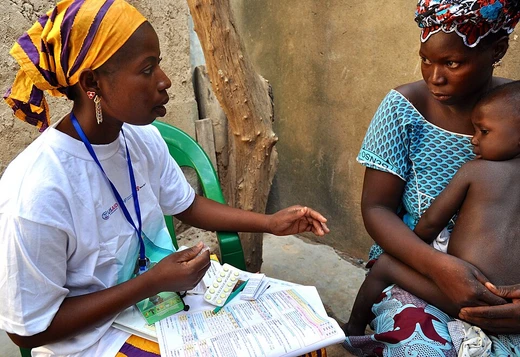
Screening (medicine)
Testing asymptomatic people for early disease detection and intervention.

Screening in medicine is a strategy used to test for as-yet-unrecognised conditions or risk markers in individuals or populations without symptoms or signs of the disease being screened. Screening interventions are designed to identify conditions which could at some future point turn into disease, thus enabling earlier intervention and management in the hope to reduce mortality and suffering from a disease. Although screening may lead to an earlier diagnosis, not all screening tests have been shown to benefit the person being screened—overdiagnosis, misdiagnosis, and creating a false sense of security are some potential adverse effects. Several types of screening exist, including universal (population-based) screening, case finding, and targeted or stratified screening.
- Definition
- Testing for unrecognised conditions or risk markers in asymptomatic individuals or populations
- Purpose
- Enable earlier intervention and management to reduce mortality and suffering
- Potential adverse effects
- Overdiagnosis, misdiagnosis, false sense of security, inappropriate overuse
- Key criteria (1968 WHO)
- Condition should be important; treatment available; latent stage exists; test acceptable; natural history understood; cost balanced; continuous process
- Key criteria (2008 WHO)
- Respond to recognized need; defined objectives; scientific evidence; quality assurance; informed consent; benefits outweigh harm
- Common types
- Mass screening, high-risk/targeted screening, multiphasic screening
- Examples
- Cancer screening (Pap smear, mammography, colonoscopy), hearing screening in newborns, scoliosis screening (controversial)
Lore & Background
These criteria state that the condition should be an important health problem, there should be a treatment, facilities for diagnosis and treatment should be available, there should be a latent stage, a test should exist and be acceptable, the natural history should be understood, there should be an agreed policy on whom to treat, the total cost should be economically balanced, and case-finding should be a continuous process.
Reader's Guide
Screening is a cornerstone of preventive medicine, but its application requires careful balancing of benefits and harms. The Wilson and Jungner criteria remain broadly applicable today, emphasizing that screening should only be undertaken for important health problems with available treatments and a latent stage. Screening is not diagnostic and often has significant rates of false positives and false negatives. In the United States, recommendations are provided by the United States Preventive Services Task Force; in the UK, by the UK National Screening Committee. Common screening programmes include cancer screening (cervical, breast, colorectal), hearing screening in newborns, and screening for social determinants of health under policies like the Affordable Care Act. Controversies exist, such as scoliosis screening in schools, which is found in only a very small segment of the population and requires students to remove their shirts. The economic considerations must be weighed alongside notions of justice, equity, personal freedom, political feasibility, and the constraints of current law.
Did You Know?
- Screening interventions are not designed to be diagnostic and often have significant rates of both false positive and false negative results.
- In the US, frequently updated screening recommendations are provided by the United States Preventive Services Task Force.
- Scoliosis screening in schools is controversial because it is found in only a very small segment of the population and requires students to remove their shirts.
Roots in Language and the Hippocratic Vision
The word epidemiology carries a deceptively simple meaning drawn from three Greek components: epi meaning 'upon' or 'among,' demos meaning 'people,' and logos meaning 'study.' Together they paint a picture of examining what sits upon or among human populations. Yet the term itself is relatively young in formal usage. Long before that, the Greek physician Hippocrates, a student of Democritus and often called the father of medicine, had already drawn the crucial distinction between diseases that are endemic—present in certain places but not others—and those that are epidemic, appearing at particular times. He also sought a rational logic behind sickness, examining how environmental factors related to the occurrence of illness. His framework of the four humors—black bile, yellow bile, blood, and phlegm—shaped centuries of treatment through bloodletting and dietary adjustment. The field has since expanded far beyond human populations, encompassing veterinary epidemiology (formerly called epizootiology) and even botanical studies of plant disease.
Pioneers Who Challenged the Invisible
Before the microscope existed, several thinkers dared to imagine that disease was carried by living entities too small to see. In mid-sixteenth-century Verona, Girolamo Fracastoro proposed that invisible, self-multiplying particles spread through the air and could be destroyed by fire, directly challenging Galen's miasma theory of poisonous gas.
A Discipline Woven from Many Threads
Modern epidemiology is not a single-lens science. It draws on biology to understand the mechanisms of disease, on statistics to extract meaningful conclusions from complex data, on the social sciences to trace both proximate and distal causes of illness, and on engineering for accurate exposure assessment. Its scope has broadened considerably: what once focused on infectious outbreaks now encompasses chronic conditions such as diabetes, cardiovascular disease, cancer, high blood pressure, mental illness, and obesity. The discipline also addresses the interaction of multiple diseases within a population, a concept termed syndemic. Among its major study areas are disease causation, transmission dynamics, outbreak investigation, disease surveillance, environmental and occupational epidemiology, forensic epidemiology, screening programs, biomonitoring, and the comparison of treatment effects in clinical trials. As a cornerstone of public health, epidemiology shapes policy decisions and evidence-based practice by identifying risk factors and pinpointing targets for preventive healthcare. Epidemiologists contribute to study design, data collection, statistical analysis, interpretation, and dissemination of results, including peer review and systematic review. The methodology they have developed has also influenced clinical research and, to a lesser degree, basic biological sciences.
The Broad Street Pump and a Legacy in Motion
John Snow's investigation of nineteenth-century cholera epidemics stands as the founding moment of modern epidemiology. By noticing that death rates were markedly higher in two London areas served by the Southwark Company, he traced the Soho outbreak to a single Broad Street pump. His decisive intervention—treating the water with chlorine and removing the pump handle—halted the epidemic and is widely regarded as a landmark in public health history that helped shape disease-prevention policies worldwide. Yet Snow's findings were not fully embraced during his lifetime. The dominant miasma theory, which blamed poor air quality for illness, was used to rationalize high infection rates in impoverished neighborhoods rather than confronting the real underlying problems of inadequate nutrition and sanitation. It was only after his death that his research and preventive recommendations gained wider acceptance. Today, the legacy of that moment lives on in every epidemiologist who designs studies, collects and analyzes data, amends interpretation, and disseminates findings through peer review. The field continues to apply its population-level logic to prevent disease, identify targets for intervention, and inform the evidence-based practice that underpins modern public health.
Frequently Asked Questions
Who is Screening (medicine)?
Screening (medicine) is a public health strategy that probes for hidden conditions or early risk markers in people who show no symptoms yet. It operates specifically within the asymptomatic population, searching for problems before they announce themselves.
What is Screening (medicine)'s role in the story?
Its central mission is to catch conditions at a latent stage so that treatment or management can begin earlier, ultimately lowering death rates and reducing the suffering a disease would otherwise cause.
What are Screening (medicine)'s known weaknesses?
Not every screening test actually helps the person being tested; some lead to overdiagnosis, misdiagnosis, or a false sense of security. There is also a persistent risk of inappropriate overuse, where the intervention causes more harm than good.
Why is Screening (medicine) important to the broader public health canon?
It shifts the entire paradigm from reactive treatment to proactive detection, giving clinicians a window of opportunity to intervene before a condition becomes full-blown disease. Without it, many preventable deaths and long-term complications would go unaddressed until it is too late.
More in Public Health And Epidemiology 1-19
Spotted an error? Know more?
This is a living reference — every entry is fact-audited, and reader corrections feed straight into our audit queue. Suggest an edit · See this site's audit record